Roof age can affect home insurance in two different ways. Before a loss, an insurer may use the roof’s age, material and condition to decide whether to insure the home, request an inspection or change terms at renewal. After a covered loss, the policy in force at the time of damage determines whether the roof is settled at replacement cost, actual cash value or under a roof-surface payment schedule. An older roof does not automatically mean a denied claim or an actual cash value payment. The decisive documents are the underwriting notice, declarations, policy forms and roof endorsements, along with evidence of the roof’s condition and the cause of damage.
Roof age can affect underwriting before it affects a claim
Consider a homeowner with a roof that has performed well for years. The insurer asks for its installation date before renewal and requests photographs of the shingles. The homeowner wants to know whether the company will keep insuring the house. A separate question arises if a future hailstorm damages the same roof: how much would the insurer pay to repair it?
Those questions run through different parts of home insurance. Underwriting evaluates the risk of insuring a property and the terms a company is willing and permitted to offer. Claim handling starts with an event, a cause of loss and the contract that was in force when the damage occurred. An underwriting concern about an aging roof is not, by itself, a claim determination.
Roof age can be one underwriting input because roof materials wear differently and their condition can affect the risk of future loss. Depending on the insurer’s guidelines and applicable state rules, the response might be a request for installation records, an inspection, repairs or a different coverage option. For the broader property-risk questions behind these decisions, see what makes a home insurable.
The company may also care about the type of roof. A composition-shingle roof and a metal roof installed at the same time need not receive the same underwriting treatment. Neither the roof’s age nor its manufacturer’s advertised life span establishes a nationwide insurance cutoff.
An inspection can tell the insurer more than the installation date
A roof installed many years ago may be sound, while a newer one may have missing shingles, poor drainage or unrepaired damage. Age is a useful record. Condition is evidence about the roof as it stands.
The Connecticut Insurance Department describes insurers reviewing roof age and condition through on-site inspections, aerial imagery or both. Its consumer guidance identifies damaged or missing shingles, accumulated debris and prior unrepaired damage as potential concerns. An image showing discoloration does not necessarily establish structural damage, and the department cautions against using cosmetic imagery alone as the basis for certain underwriting actions in Connecticut.
State rules also matter. The Texas Department of Insurance explains that insurers cannot decline or refuse to renew a homeowners policy solely because a roof or home is old, while physical condition may still be considered. That is a Texas rule, not a statement about every state. It illustrates why a homeowner should ask for the specific reason behind an adverse underwriting decision instead of treating an age mentioned in a letter as a universal prohibition.
If an inspection raises a concern, preserve the notice and ask which observed condition needs attention. Useful evidence may include:
- Roof installation invoices, contracts or permit records showing the work performed.
- Photos showing the present condition of roof surfaces and visible areas of concern.
- Inspection findings from a qualified roofing professional, including the scope of any recommended repairs.
- Receipts and completion photographs for repairs already made.
- Written clarification from the insurer about what documentation could change its decision.
Ask the insurer to distinguish a problem observed on inspection from a roof-age entry that may be outdated. If the issue involves a safety hazard or damage that is difficult to assess from the ground, use a qualified professional rather than attempting a risky roof inspection yourself.
Replacement cost, actual cash value and payment schedules are different
Suppose wind damages roof shingles and the event is covered. The settlement method still needs to be identified. A declarations page that shows replacement cost on the dwelling does not necessarily answer how roof surfacing is treated if a separate endorsement modifies that coverage.
| Roof settlement structure | How age or condition enters the calculation | What the homeowner needs to understand |
|---|---|---|
| Replacement cost value (RCV) | Depreciation may affect an initial payment, but the covered replacement cost can be payable after repairs and required documentation. | The policy may hold back recoverable depreciation. The deductible, limits, actual cost and conditions for later payment still matter. |
| Actual cash value (ACV) | Age, condition and expected useful life can affect the depreciation applied to the damaged property. | The depreciated amount is generally the settlement basis, rather than a temporary holdback that automatically returns after replacement. |
| Roof-surface payment schedule | A specific endorsement may assign a payment percentage by roof age and material type. | The schedule’s scope, covered causes of loss, applicable percentage and interaction with the deductible must come from the actual form. |
These are settlement structures, not promises that a roof loss is covered. First identify what caused the damage and whether the policy covers that cause. Wear, deterioration and a sudden covered event should not be treated as interchangeable. The coverage grant, exclusions, wind or hail limitations and roof endorsements may change the result. Our home insurance coverage decision map explains those earlier questions.
RCV also does not necessarily mean a full replacement check arrives before work begins. The NAIC explains that an insurer may initially pay a depreciated amount and release additional replacement cost after the repair is documented, subject to the policy. With a roof-specific ACV provision or a final payment schedule, there may be no comparable recoverable amount.
A documented payment schedule shows why the exact form matters
A roof-surface payment schedule is more specific than the statement that an old roof is worth less. It can prescribe a percentage for a particular roof material at a particular age, and that percentage may apply to the covered roof-surface repair cost as defined by the endorsement.
NAIC consumer meeting materials reproduce a State Farm roof surfaces payment schedule identified as form HO-2795. In that exhibit, the row for a roof aged at least 10 but less than 11 years lists 60% for composition shingles and 90% for metal. The same age produces very different percentages because the material columns differ.
That is a documented form example, not a current quote, a national schedule or proof that any reader has the endorsement. The exhibit does not establish which states currently permit or use that form, whether it was attached to a particular policy, or how every component of an individual claim would be classified. It shows why quoting a rule such as “roofs over 10 years old get ACV” is unreliable.
To apply a schedule to a real claim, obtain the complete endorsement and determine:
- Which covered causes of loss trigger the schedule, such as a stated wind or hail peril.
- How the form defines roof surfacing and which repair items it includes.
- Which roof material and verified age the insurer used.
- Whether the percentage limits the payable repair amount and how the deductible is applied.
- Whether any replacement cost may be recovered later, or the scheduled amount is final.
A chart found online cannot replace these contract provisions. Ask for the form number, its full text and the calculation tied to your insured roof.
A renewal can change future roof payments without ending coverage
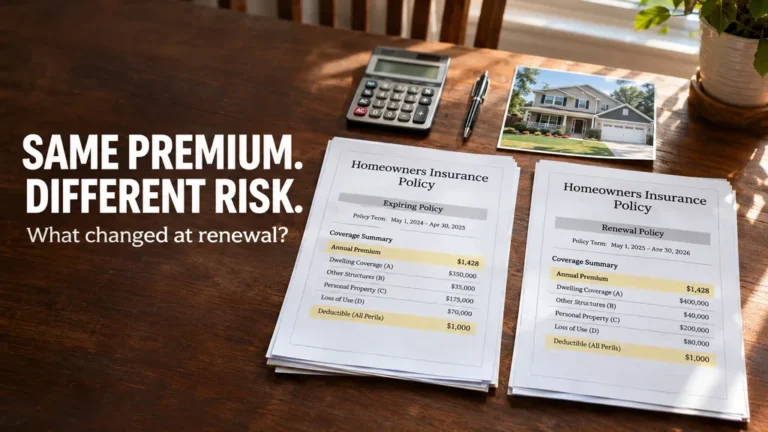
A homeowner might receive a renewal offer at a manageable premium and assume the roof is insured on the same terms. Yet a roof-specific endorsement could be added or revised while the policy continues. The important change may be the amount payable after a future covered loss, even when the homeowner never receives a cancellation or nonrenewal notice.
Use this short roof endorsement audit when comparing the current contract with the renewal packet:
| Roof item to record | Current policy | Renewal offer |
|---|---|---|
| Roof settlement basis | Copy the RCV, ACV or schedule provision. | Record whether the method changes. |
| Roof endorsement | Record its exact form name and number, if any. | Check added, removed or revised forms. |
| Roof age and material | Record the insurer’s listed or confirmed information. | Correct any inaccurate age or material entry. |
| Wind, hail or roof deductible | Record the applicable amount or percentage. | Calculate the dollar impact using the new dwelling limit if relevant. |
| Underwriting requirement | Keep any inspection or repair notice. | Record the requested evidence and response instructions. |
Start with the declarations and endorsement schedule, then request any missing forms or change notices. A premium comparison cannot show whether a roof payment schedule was added. For the wider set of policy changes to review, use our renewal policy change checklist.
If the insurer is considering nonrenewal rather than offering altered terms, the notice raises a separate coverage-continuity issue. The guide to keeping home insurance coverage explains how to identify the kind of notice and the next decision. Do not assume that a renewal offer, repair request and nonrenewal notice have the same effect.
One covered roof loss, three different final settlement amounts
Assume a covered wind event causes roof-surface damage that requires $20,000 of eligible repairs. Assume a $2,000 deductible, no other applicable limit, and no dispute about the repair scope. For the ACV example, assume the insurer applies $9,000 in depreciation under the policy. For the payment-schedule example, assume the actual endorsement states that 60% of these same eligible costs is payable and that the percentage is applied before the deductible.
Those assumptions produce three different results:
- RCV: The full covered replacement-cost settlement is $20,000 minus the $2,000 deductible, or $18,000. If the policy initially withholds $9,000 of recoverable depreciation, the first payment is $9,000 and the remaining $9,000 may become payable after covered repairs and required proof.
- ACV: $20,000 minus $9,000 depreciation minus the $2,000 deductible equals a $9,000 payment. Under the assumed ACV-only roof provision, completing the replacement does not release the depreciation.
- Scheduled roof-surface settlement: $20,000 multiplied by 60% equals $12,000. After the $2,000 deductible, the payment is $10,000. Under the assumed final schedule, there is no additional roof-surface replacement-cost payment.
The 60% assumption illustrates the kind of percentage shown in a documented schedule; this calculation does not purport to apply the State Farm exhibit to an actual claim. A different policy could define eligible items differently, use another age or material column, apply another deductible or exclude the event altogether. The $9,000 ACV depreciation is also hypothetical, not an industry formula.
For a claim already underway, request an itemized estimate that separates covered repair cost, depreciation, the schedule percentage if used, deductible and any recoverable amount. Our explanation of how home insurance claims are paid follows those amounts from estimate to settlement.
What replacing your roof can change about your insurance
Replacing a worn roof can resolve a documented property-condition concern. It can also give the insurer more accurate information about material type and installation age. Depending on the carrier and policy options, an updated roof record may affect underwriting eligibility, an inspection request, pricing or the availability of a different roof settlement endorsement.
A new roof does not automatically remove an ACV provision, restore replacement cost settlement or guarantee a premium reduction. The insurer may need to approve a policy change, and state rules and other property risks still apply. Nor does a replacement performed now rewrite the contract that governed damage occurring before the replacement.
After the work is completed, keep the contractor’s final invoice, permit closeout if applicable, material information, warranty and clear completion photos. Send the relevant documentation through the carrier or agent’s normal process and ask for written confirmation of the roof details recorded on the policy. If you seek different roof coverage, request the exact new endorsement and its effective policy terms before assuming the change has been made.
Match each roof question to the document that answers it
| Your question | Document or evidence to find | Question to ask the insurer |
|---|---|---|
| Why is my roof being reviewed? | Underwriting or inspection notice; roof-condition report. | Is the concern age, material, observed condition or an inaccurate record? |
| Will my policy be renewed? | Renewal offer, repair request or nonrenewal notice. | What decision has been made, and what documentation can be submitted? |
| Is this roof damage covered? | Policy in force on the loss date, relevant exclusions, endorsements and cause-of-loss evidence. | Which provisions apply to the reported event and damaged items? |
| Why is the roof payment lower than the estimate? | Loss settlement clause, roof endorsement and itemized claim calculation. | Is the difference depreciation, a schedule, a deductible, a scope issue or a limit? |
| Did replacing the roof change my insurance? | Installation records, updated declarations and any revised endorsement. | What roof data and coverage terms are now reflected in the issued policy? |
Keep earlier declarations and endorsements as well as the renewal version. If a claim occurs after a policy change, the contract effective when the loss happened is the starting point for the settlement analysis. A more recent document may help explain what changed, but it does not automatically control an earlier loss.
Final thoughts: separate the roof decision from the roof payment
For an underwriting question, establish the roof’s actual age, material and present condition, then get the insurer’s reason for its decision in writing. For a claim question, identify the cause of damage and the roof settlement provision in the policy that covered the loss. Comparing those two records prevents an insurance inspection, an ACV calculation and a payment schedule from being mistaken for the same rule.
If something remains unclear, ask for the exact form or calculation rather than an informal statement about how old roofs are treated. The answer may turn on one endorsement, one incorrect roof detail or a rule specific to your state.
Frequently asked questions
Will home insurance cover a roof that is 20 years old?
Age alone does not answer whether a loss is covered. Determine what damaged the roof, then check the policy’s covered causes of loss, exclusions and any roof-specific endorsement. Underwriting eligibility and how much a covered claim pays are separate questions.
Does an old roof automatically receive actual cash value coverage?
No. An insurer may offer replacement cost, actual cash value or a limited roof-surface schedule, depending on its forms and the applicable rules. Look at the endorsement schedule and the roof loss settlement wording, not just the roof’s installation year.
Can a roof inspection change a renewal decision?
Inspection evidence may clarify a condition concern or correct outdated information, although it does not guarantee the insurer will renew. Ask what finding drove the decision, provide qualified documentation and check the notice requirements in your state if coverage may end.
Is a roof payment schedule the same as ACV?
Not necessarily. ACV generally uses depreciation tied to the property’s age and condition, while a schedule may prescribe percentages by roof age and material. The endorsement determines its scope, deductible treatment and whether the scheduled settlement is final.
Will replacing my roof automatically give me replacement cost coverage?
No. Send installation documentation to the insurer and request confirmation of the updated roof details. If you want an ACV or scheduled roof endorsement removed or revised, ask for the available coverage options and the issued form showing any approved change.
References and sources
- National Association of Insurance Commissioners, actual cash value and replacement cost overview: definitions of the two valuation approaches and the role of depreciation.
- National Association of Insurance Commissioners, Post-Disaster Claims Guide: roof-specific ACV limits, deductibles and the possibility of recoverable depreciation under replacement cost coverage.
- NAIC Consumer Liaison Committee meeting materials: reproduced State Farm HO-2795 roof surfaces payment schedule used only as a documented form example.
- Connecticut Insurance Department, roof risk FAQs: how roof age, condition and inspection evidence can enter underwriting in Connecticut.
- Texas Department of Insurance, roof-age underwriting clarification: the distinction between an age-only underwriting decision and a decision based on physical condition under Texas rules.